
-In Kenya’s fast-growing construction industry, the perception that falling tools, debris, or materials are simply “part of the job” is no longer acceptable. Company directors and CEOs carry a duty of care and are ultimately accountable for any commission or omission that place workers and the public at risk.
A breach of this duty of care may attract either or both civil and criminal litigation. The ability of a company to compensate victims does not absolve it from the responsibility of actively implementing effective controls to safeguard lives. Compensation alone cannot undo the harm caused, nor should it serve as a shield against accountability.
Criminal liability is therefore essential to ensure that safety is not treated as a negotiable cost of doing business, but as a fundamental obligation. By holding leaders personally accountable, the law reinforces the principle that protecting human life must take precedence over profit, convenience, or expediency. Various jurisdictions have enacted laws highlighting consequences that organizations and directors may face.
According to Kenya OSHA 2007 If a person dies or suffers injury due to a workplace contravention the occupier or owner faces a fine up to KES 1 million or imprisonment up to 12 months.
In the UK A Three-Tiered Framework is present with Corporate Manslaughter and Corporate Homicide Act 2007 applied to organisations where serious management failures have caused gross breach of duty of care with unlimited fines, remedial orders, and publicity orders. Health and Safety at Work etc. Act 1974 (HSWA)Section 37 allows prosecution of directors/managers if offences occur due to their consent, connivance, or neglect with consequence been fines and imprisonment. Gross Negligence Manslaughter (Common Law) applies to individuals. Directors can face personal liability if their negligence leads to death and penalty can lead to life imprisonment.
In the US OSHA 1970 Section 17 detailed penalties imposed on the employer due to non-compliance. Any employer who wilfully violates any standard, rule, or order promulgated pursuant to section 6( occupational safety and Health standards) or of any regulations prescribed pursuant to this Act, and that violation caused death to any employee, shall, upon conviction, be punished by a fine of not more than $10,000 or by imprisonment for not more than six months, or by both; except that if the conviction is for a violation committed after a first conviction of such person, punishment shall be by a fine of not more than $20,000 or by imprisonment for not more than one year, or by both.UK-Prosecution – HSE Media Centre
Kenya-Case Law – Kenya Law
USA- Search – Enforcement Data – U.S. Department of Labor
Every dropped object is a potential tragedy waiting to happen whether it’s a hammer slipping from scaffolding or unsecured materials tumbling from high-rise projects. All objects falling on earth are subjected to gravity. Gravity accelerates objects downward and increases the velocity, momentum, and kinetic energy of objects as they descend. On impact, this energy must be dissipated, often through damage to the body or surface struck. Small objects like bolts, though light, can be deadly because their force is concentrated on a tiny area, creating high pressure that may penetrate the skull or vital organs. Larger objects such as building blocks distribute force over a wider area, resulting in moderate pressure, but their greater mass makes them capable of crushing the head or chest, leading to blunt trauma and fatal injuries.
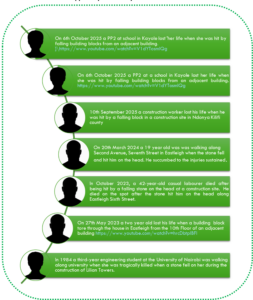
Notable fatalities from dropped objects in Kenya:-
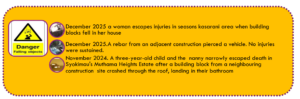
Other dropped objects from construction site: –
Due to inaction by developers and relaxed oversight from regulators, falling objects will continue to rob families of their loved ones and leave lasting emotional scars. This begs the question what solutions lie in eliminating dropped objects from construction sites? How do we stop dropped objects before they stop us?
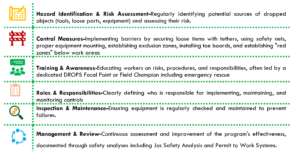
The solution lies in development and implementation of a comprehensive Dropped Objects Prevention Program (DOPP). A Dropped Objects Program is a safety initiative designed to prevent injuries and damage caused by falling objects at worksites.
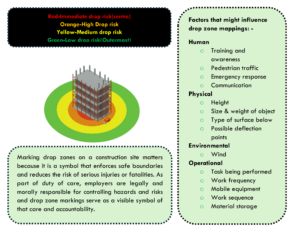
A Dropped Objects Program comprises of: –
Deaths caused by falling objects are not mere numbers on a report. They represent individuals with dreams, families, and communities who depended on them. Each life lost is a future cut short, a story unfinished, and a family left to grieve. Behind every statistic is a worker who hoped to build a career, a parent striving to provide, or a young person envisioning a brighter tomorrow.
While an organization may recover from financial losses, lawsuits, or even bankruptcy and move on to rebrand, a life lost can never be restored. Human life is sacred, and fatalities caused by falling objects must be met with the full force of the law. Directors should be held accountable, and beyond civil compensation, they must face criminal prosecution to ensure justice is served.
Safety is not just about compliance but protecting lives, preserving futures, and honouring the dignity of every person. In Kenya, where construction is shaping skylines and livelihoods, safety must shape our legacy. Dropped objects are preventable and treating them as “business as usual” belongs to the past.
Further reading resources:-
1. The American National Standard for Dropped Object Prevention, ANSI/ISEA 121-2018
2. Kenya Occupational Safety and Health Act (OSHA) 2007
3. Kenya Workers Injury Benefits Act 2007
4. UK Corporate Manslaughter & Corporate Homicide Act 2007
5. UK Health and Safety at Work Act (HSWA)1974
6. UK Gross Negligence Manslaughter (Common Law)
7. USA Occupational Safety and Health Act (OSHA) 1970
