
Secondary asbestos exposure is an unexpected and patient killer. Many victims of secondhand exposure to asbestos have no idea they were ever around the deadly mineral until they are diagnosed with mesothelioma or a similar illness. Learn more about secondary exposure and determine whether you were at risk.
The Unseen Danger of Asbestos: What Is Secondary Exposure?
Secondary asbestos exposure occurs when a person comes into contact with the toxic material’s fibers through someone who was directly exposed to it. In general, the person directly exposed carried asbestos home on their clothes, hair, or equipment, exposing their family members, who could inhale or ingest the tiny fibers.
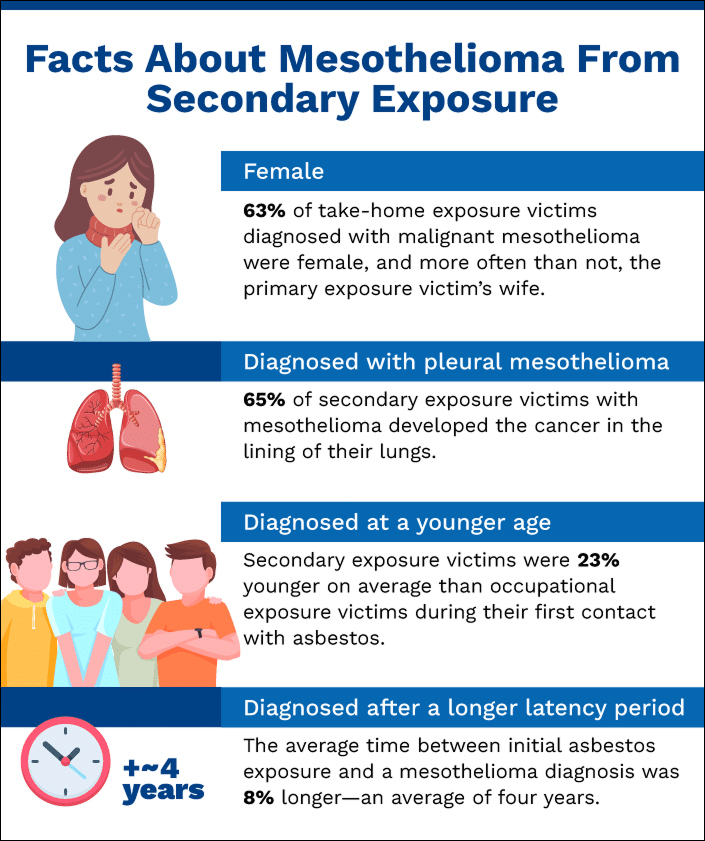
Women and children are the most common victims of secondary asbestos exposure. Recent studies estimated that as many as 30% of U.S. mesothelioma cases are potentially related to secondary asbestos exposure, especially those among women or younger adults who never worked in fields traditionally linked to asbestos.
How Did Families Suffer from Secondhand Asbestos Exposure?
Most asbestos-related illnesses diagnosed today, including those related to secondary exposure, result from asbestos exposure that happened decades ago. Until the 1970s, the public was largely unaware of the dangers of asbestos. Until asbestos use was largely phased out in the late 20th Century, it wasn’t unusual for workers to come home covered in asbestos dust.
Asbestos fibers are lightweight and microscopic, making it easy for billions of fibers to quickly spread and land on objects and people without anyone knowing. Whenever asbestos is disturbed, such as when a family member sits on furniture or enters a vehicle, or when the heat or air conditioning comes on, any asbestos present can become airborne, allowing family members to inhale or ingest it.
How Did Secondary Asbestos Exposure Occur in the Household?
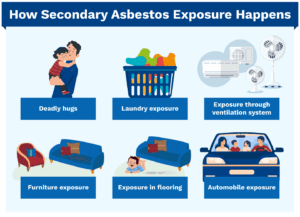
When a worker carries the fibers home, family members can be exposed to asbestos through the following:
- Deadly hugs: Loved ones hug a contaminated worker upon arriving home.
- Laundry exposure: A family member shakes contaminated clothing to remove asbestos dust or launders it, directly exposing the family member and spreading the fibers throughout the home.
- Exposure through ventilation systems: Asbestos fibers accumulate in the home over time and enter the heating and cooling system, easily passing through most air filters.
- Furniture exposure: Contaminated workers use beds, couches, and other furniture, allowing asbestos fibers to accumulate over time.
- Exposure in flooring: Asbestos fibers fall from the worker onto the carpet or floor, where they are disturbed every time a family member walks by, plays, vacuums, or sweeps.
- Automobile exposure: Family members ride in the vehicle that the exposed worker drives home from work and inhale highly concentrated asbestos over a long period.
Is Secondary Asbestos Exposure The Same As Environmental Asbestos Exposure?
Secondary asbestos exposure is often confused with environmental asbestos exposure, but they are two distinct types of exposure.
- Environmental exposure occurs when a worker is present where someone else handles raw asbestos or asbestos is disturbed, whether in a product, component, or naturally occurring deposit.
- Secondary asbestos exposure occurs when a family member exposed to asbestos carries the material from the source and introduces it into an environment.
Environmental asbestos exposure qualifies as passive exposure because it occurs without the exposed person directly handling asbestos. Secondary asbestos exposure can occur through environmental exposure, such as when asbestos fibers enter the home ventilation system.
What Are the Risks of Secondary Exposure to Asbestos?
When asbestos is disturbed, microscopic fibers get released into the air. While asbestos fibers are undetectable to the naked eye, they are easily inhaled when airborne. The body can’t break down or expel most asbestos fibers, so they are lodged deeply into tissues instead, where they can quietly cause damage over time.
Regardless of how one is exposed to asbestos, the lingering fibers can cause them to develop fatal diseases decades later. In most cases, no warning signs or symptoms develop until an advanced disease manifests, after which it often progresses rapidly. Diseases commonly associated with asbestos exposure include:
- Mesothelioma: An aggressive form of cancer that impacts the linings around the lungs, stomach, or other internal organs
- Asbestos lung cancer: Cancer that develops inside the lungs
- Asbestosis: Scarring of the lungs that can cause pain and difficulty breathing
- Pleural plaques: Thickening of the membranes around the lungs
Mesothelioma Risk Profile from Secondhand Exposure
While there is no safe level of asbestos exposure, victims of secondary exposure often came into contact with higher concentrations of asbestos than one might expect. The concentrations of asbestos found in the lungs of some household exposure victims were similar to those found in shipyard industry workers, one of the occupations most strongly linked to historical asbestos exposure.
Secondary exposure victims are often vulnerable to mesothelioma cancer and other asbestos-related diseases, which can take decades to develop after initial contact with asbestos fibers.
9 Things Women Should Know About Mesothelioma from Take-Home Asbestos Exposure
The most common victims of secondary asbestos exposure are women. Here are nine facts about take-home asbestos exposure and its impacts on women:
- Nearly one in four women who die from mesothelioma were exposed to asbestos as homemakers.
- Peritoneal and ovarian mesothelioma can be easily misdiagnosed as ovarian cancer, but the optimal treatments for each condition differ.
- Women exposed to asbestos in the home have an average latency period roughly four years longer than men exposed at work, although there is no clear consensus for a reason.
- Children exposed at home have an even longer average latency period than homemakers. However, women exposed to asbestos at work still had a longer latency period for pleural mesothelioma on average than men.
- Women are often exposed to asbestos through lesser-known sources. Therefore, doctors may rule out a mesothelioma diagnosis without testing for it.
- Similarly, health care professionals can often misdiagnose mesothelioma in women as lung cancer, pneumonia, or an upper respiratory infection.
- In rare cases, untreated pleural mesothelioma can spread to the breasts and present as breast cancer.
- Pericardial asbestos, which impacts the lining of the heart, was misdiagnosed as lupus in at least one woman’s case.
- Women with mesothelioma are much more likely to survive longer than men, with hormones potentially contributing to the difference.
Secondary Asbestos Exposure in Pets